
Executive Summary
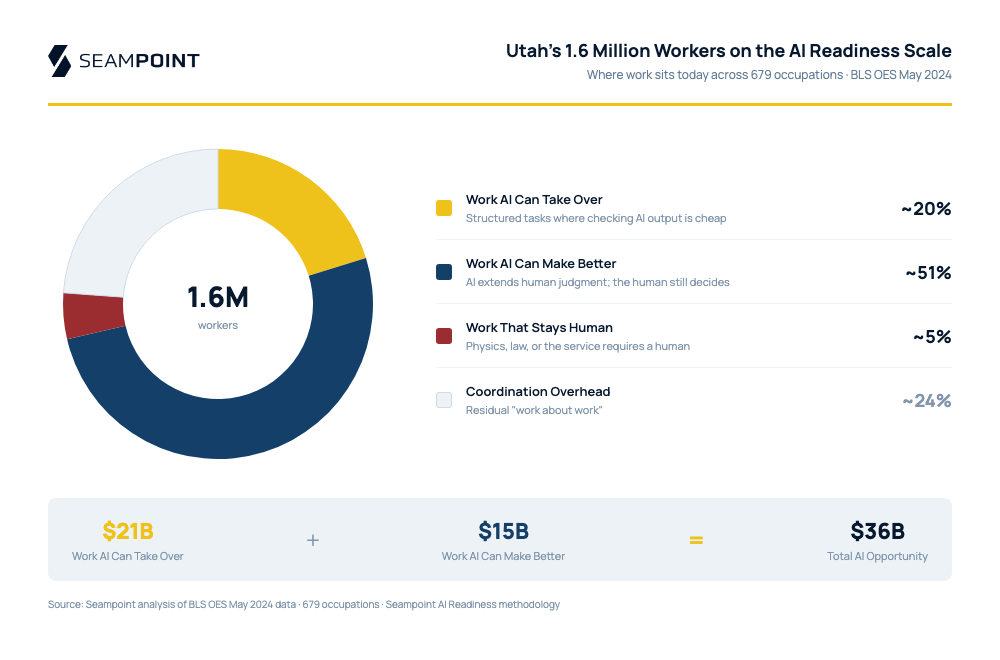
We analyzed Utah’s entire workforce, 1.6 million workers earning $104 billion in annual wages across 679 occupations, with a simple question: where can organizations actually deploy AI safely today? Four constraints govern every deployment decision:
-
What happens if the AI gets it wrong?
-
How hard is it to check the AI’s work?
-
Who is accountable for the outcome?
-
Does the work require a human body in a physical space?
Then we went deeper. We examined 20 real Utah employers, from Intermountain Health’s 68,000 caregivers to Kirton McConkie’s 302 attorneys, to see how the statewide patterns play out inside specific organizations.
Three major findings:
About 20% of Utah’s work hours can be shifted directly to AI now. That’s roughly $21 billion in wages and the equivalent of 330,000 full-time jobs. Some of this is core task work that transfers to AI entirely: processing forms, classifying documents, logging interactions, reconciling records. Some of it is coordination time that gets faster: AI drafting emails, summarizing meetings, generating status updates. Both are concentrated in office and administrative work, retail, food service, and customer-facing roles where checking AI output is cheap and mistakes are manageable. Organizations can capture this value with planning and execution. It doesn’t require new governance infrastructure.
Half of the immediately shiftable work is in jobs paying $35,000 to $55,000. These are administrative, clerical, and customer service roles where workers have families and mortgages but might lack the professional networks and financial reserves that cushion higher-wage workers during transitions.
About half of Utah’s work hours sit where AI can make people better at their jobs, and that’s the harder, larger opportunity. Engineers iterating designs. Nurses using AI-drafted clinical summaries to spend more time with patients. Financial analysts pressure-testing investment theses. In these roles, AI extends human judgment rather than replacing it. Capturing this value requires a learned ability to use AI as a thinking partner rather than a fast assistant. Anthropic’s own deployment data confirms this. Experienced AI users achieve measurably better outcomes, and they get there by shifting from handing tasks off to AI toward collaborative, iterative patterns. Making people permanently better at their jobs is a larger long term opportunity than the one time boost of shifting certain tasks to AI. Utah employers are not yet systematically driving toward that larger prize .
About 5% of Utah’s work stays with humans because it must. Construction trades, clinical procedures, aircraft maintenance, public safety, hands-on patient care. Physics, law, or the nature of the service requires human presence, authority, or judgment that cannot transfer to AI. Utah’s economic anchors (defense, healthcare, construction) are the sectors where this work concentrates most. The same constraints that limit AI deployment also anchor jobs geographically.
An important distinction: work shifting is not jobs shifting. When 20% of a bookkeeper’s tasks migrate to AI, the bookkeeper doesn’t disappear, they just get more productive at other tasks. The role concentrates more onto the judgment and problem-solving tasks that AI can’t do. Across Utah’s workforce, about 20% of work can shift to AI. About 50% can get better with AI. The first is worth planning for. The second is worth competing for.
Utah’s Economy: A Three-Tier Structure
Utah led the nation in real GDP growth in 2024 at 4.5% (Bureau of Economic Analysis). One year later, the state ranked 35th, with Q3 2025 growth of 4.1%, below the national average of 4.4%. The economy is still growing, but it’s no longer outrunning everyone else. Unemployment rose from 3.0% to 3.6%, and employment growth slowed to 1.5%, well below Utah’s historical pace. The economy is expanding but the labor market is tightening. That combination of growth without abundant labor is exactly the environment where AI deployment shifts from interesting to urgent.
Tier I: Utah’s Sustainable Core (~390,000 workers, ~24% of employment, ~42% of GDP). Four sectors that export goods, services, or intellectual property beyond state borders make up what we call Utah’s Sustainable Core business sector.
Aerospace and Defense: Hill Air Force Base alone accounts for $12.8 billion in annual economic impact and is the state’s largest single-site employer. The federal civilian workforce in Utah totals roughly 34,400 across all agencies (defense, IRS, VA, Forest Service, and others), with defense comprising the largest share. Federal appropriations provide counter-cyclical stability that no other Utah sector enjoys.
Technology and Software: More than 70,000 workers in computer and mathematical occupations alone, with average wages above $100,000. Silicon Slopes built Utah’s reputation as a technology hub, but the original cohort of breakout companies is consolidating rather than expanding. Most have been absorbed through private equity acquisitions or strategic transactions; Pluralsight relocated its headquarters to Texas in 2025. The question for Utah’s technology economy isn’t whether the cluster matters—it clearly does, at 70,000 jobs—but whether it can produce a second generation of AI-native companies that become major employers. The companies that defined Silicon Slopes grew up in the SaaS era. The AI transition rewards a different kind of company. Utah will need to figure out how to invest in and support their homegrown AI-native startups as well as reaching out to entice AI-based business operations elsewhere to relocate.
Advanced Manufacturing: Roughly 85,000 production workers across medical devices (top-5 national cluster), aerospace composites, and specialty chemicals, with tens of thousands more in engineering, maintenance, and support roles at manufacturing employers.
Tourism and Outdoor Recreation: Nearly 100,000 direct jobs backed by a permanent geographic endowment of five national parks and world-class ski resorts, with $12.7 billion in visitor spending in 2023.
Tier II: The Support Economy (~210,000 workers). High-value services that recirculate Core wealth: healthcare, professional services, financial services. When this tier expands, Core prosperity is thick enough to support sophisticated local consumption. When it contracts, Core stress is propagating.
Tier III: Cyclical and Speculative. The combined finance, insurance, and real estate sector’s 21.9% GDP share is dangerously high. Construction employment (more than 110,000 in construction trades occupations alone) reflects a building boom visible in the occupational data: plasterers at 5.2x national concentration, tile setters at 4.5x.
Each tier has a different AI profile. The Core economy concentrates in sectors where much of the work must stay human—physical reality and authority constraints anchor those jobs. The Support Economy concentrates in sectors where AI extends human judgment but cannot replace it.
Part 1: Utah’s Full Workforce—Where AI Applies and Where It Doesn’t
Every hour of work performed by Utah’s 1.6 million workers falls into one of four categories:
Work AI can take over (~20% of hours). Structured tasks where the AI can do the work if a human checks the output. The checking is cheap and mistakes are manageable. This 20% includes both core work tasks that could transfer to AI entirely (a bookkeeper’s reconciliation work, a clerk’s document classification) and time savings from AI speeding up the coordination work that burdens every role (email, meetings, status updates, internal reporting).
Work AI can make better (~51% of hours). Judgment-intensive roles where AI can substantially extend what a human can do, but the human still needs to make the decisions, either because checking the output requires expertise or because some person still needs to be held accountable.
Work that stays human (~5% of hours). Tasks where physics, law, or the nature of the service still requires a human body, a human license, or human authority.
Coordination overhead (~24%). Email, meetings, status updates, internal reporting. AI is already reducing this (the 20% figure above includes those savings), but most of it remains to be explored. It will continue to shrink as tools mature and workers build awareness and expertise. (See Methodology Companion, Section 3.2, for the full calculation.)
By occupation cluster
AI Readiness by Occupation Cluster
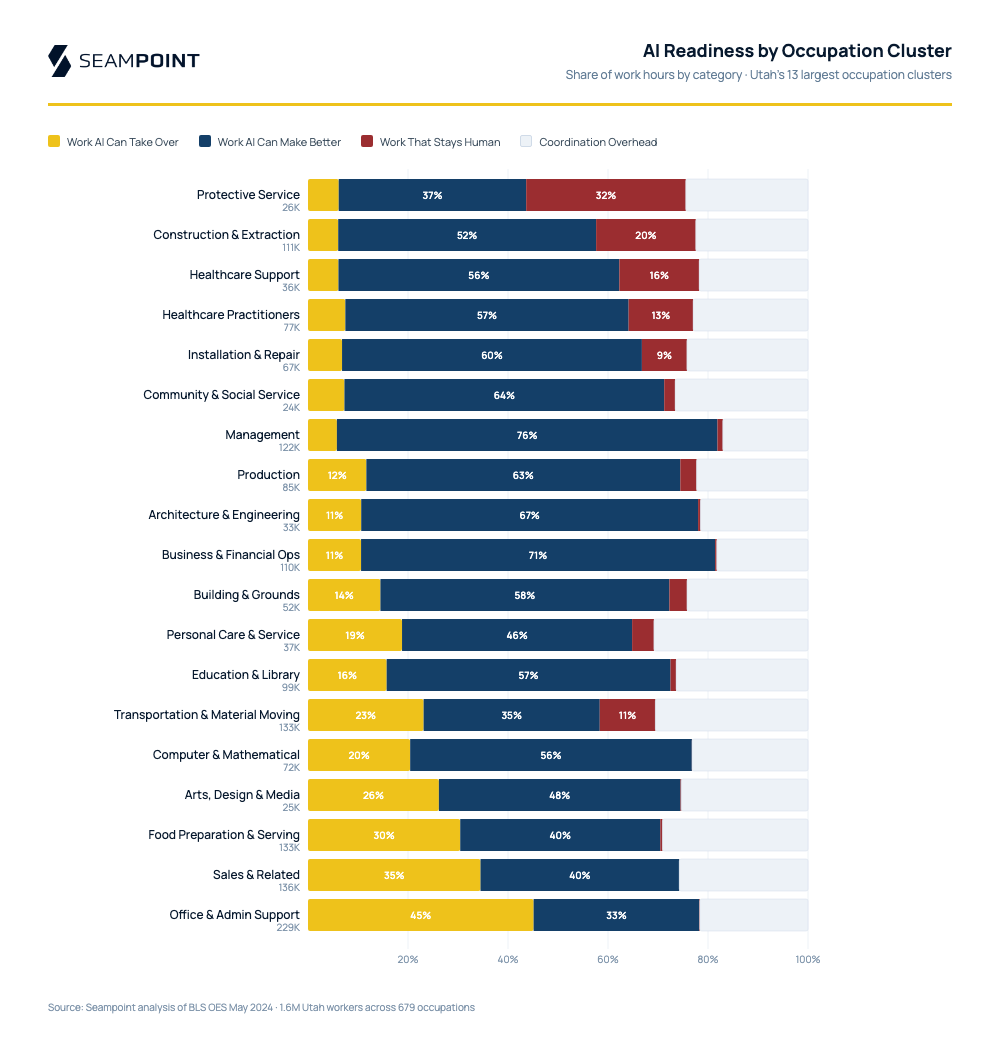
The pattern varies dramatically by occupation. (Full data by cluster in Appendix A.)
Where AI can take over tasks directly: Office and administrative workers (229,000 in Utah) have the most work AI can take over. Nearly half their work hours involve structured tasks where AI output is cheap to check. Sales workers (136,000) and food service workers (133,000) follow close behind. These are the roles where forms get processed, transactions get logged, and customer inquiries get routed. Utah’s above-average concentration in office and administrative work is one reason the state has more work that can shift to AI than the national average.
Where AI makes people better at their jobs: Managers (122,000 workers, 76% of hours), business and financial professionals (110,000 workers, 71%), and production workers (85,000 workers, 63%) have the highest shares of judgment-intensive work that AI can improve but not replace. AI can accelerate analysis, surface options, and stress-test decisions. The human still makes the call.
Where work stays human: Protective service workers (32% of their hours), construction and extraction workers (20%), and healthcare practitioners (13%) have the highest shares of work that still require human presence, authority, or physical capability. These clusters anchor Utah’s employment base and concentrate in Utah’s Sustainable Core economy.
What does this look like in practice? The work AI can take over has two distinct components, and the workforce implications of each are different.
The first is core work task transfer: specialized tasks that define the role but happen to be structured enough for AI to perform with cheap verification. A bookkeeper recording transactions in accounting software and reconciling accounts. A customer service representative logging interaction details and processing contract forms. A retail salesperson computing prices and processing payments. An administrative assistant creating and maintaining database records. These are tasks the worker was hired to do. They are the job, or at least they were. When these tasks migrate to AI, the role changes character. The bookkeeper shifts toward exception handling and financial analysis. The customer service representative spends less time on documentation and more on problem resolution. The admin assistant moves from data entry to coordination and judgment calls. This is role distillation: the job doesn’t disappear, but its composition shifts toward the parts of the job that require human judgment.
The second component is coordination overhead savings: the “work about work” that accumulated around every role regardless of specialty. A software developer preparing status reports and project correspondence instead of writing code. A nurse documenting shift transitions and chasing referral authorizations instead of caring for patients. A manager triaging email and building meeting agendas instead of making decisions. Nobody was hired to do this work. It piled up over decades as organizations added layers of process. When AI reduces this coordination overhead, the core job doesn’t change. The worker just gets more time for the work they were actually hired to do.
The binding constraint: housing
The tightening labor market described above has a structural driver: housing. The median home price multiple reached 5.1 in 2024 (Gardner Policy Institute), crossing into “severely unaffordable” territory by standard classifications. Core prosperity attracts in-migration, which overwhelms housing supply, which pushes workers out. Organizations facing both shrinking labor supply and rising costs have a structural incentive to pursue AI where governance permits. Shifting structured work to AI is more than just theoretically interesting. For labor-constrained Utah employers, it’s practically urgent.
Part 2: What It Looks Like Inside 20 Real Employers
State-level data reveals the pattern. Employer-level data shows what it looks like in a specific organization with real roles, real systems, and real constraints.
We analyzed 20 Utah employers representing 168,000 workers, about 10% of the state’s workforce, spanning all three economic tiers.
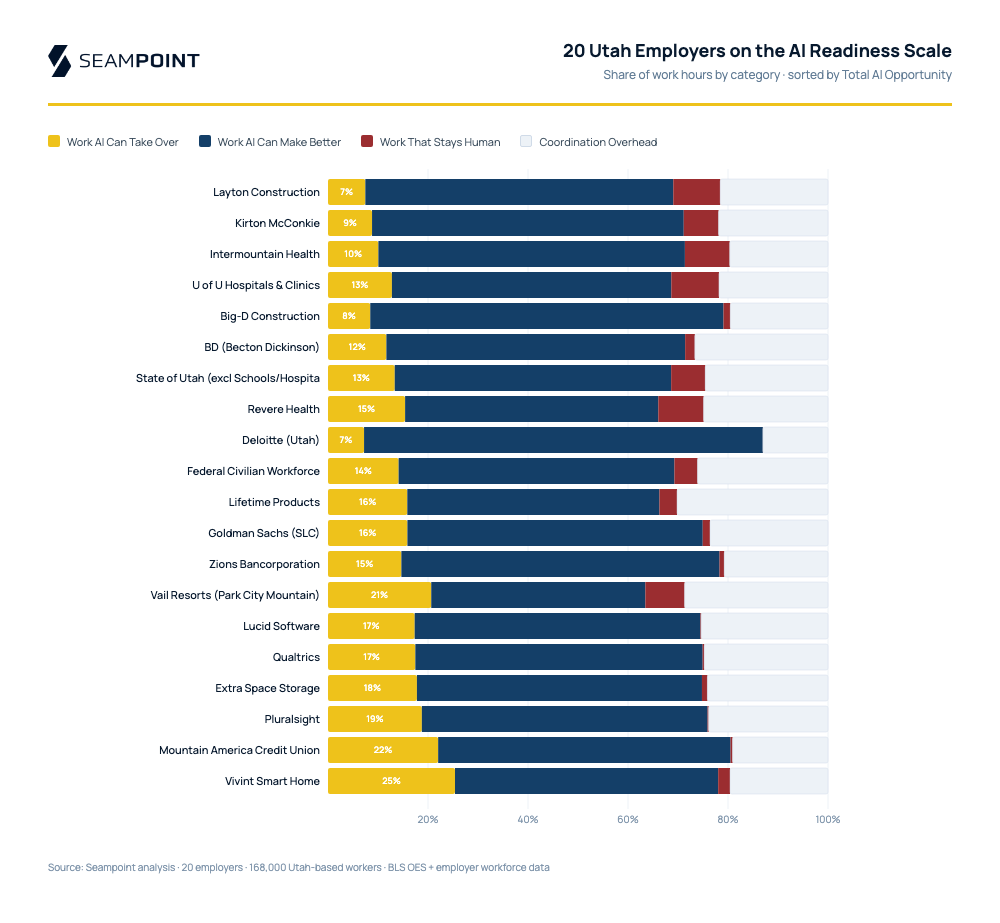
The 20 employers we examined span healthcare, defense, government, financial services, technology, construction, manufacturing, tourism, professional services, legal, and real estate. (Full employer data in Appendix B.) The range is striking: Vivint Smart Home (AI can take over 25% of work) and Layton Construction (8%) sit at opposite ends, reflecting the difference between a customer-service-heavy tech company and a builder whose core work is physical labor. But across all 20, the same pattern holds. The biggest opportunity for shifting work to AI is in the judgment-intensive work it can improve, not the tasks it can take over.
The sample vs. the state
The employer sample shows a lower share of work AI can take over (12%) than the statewide analysis (20%). This reflects the composition of the sample which is heavily weighted toward healthcare (87,000 workers) and defense (34,000), both sectors where the opportunities to shift work to AI are smaller. The state workforce includes 229,000 office and administrative workers (45% of hours) and 137,000 food service workers (30%) that don’t appear proportionally in our 20 employer sample.
The shift-to-AI opportunity is largest in the sectors our employer sample underrepresents: mid-size employers, back-offices, call centers, and restaurant chains. The larger employer profiles in this report show the harder cases. The easier gains are distributed across thousands of smaller organizations.
Eight sectors, eight stories
Healthcare: The physician who can’t delegate liability
| Employer | Type | Workers | AI Can Take Over | AI Can Improve | Stays Human |
|---|---|---|---|---|---|
| Intermountain Health | Integrated system | 68,000 | 10% | 61% | 9% |
| U of U Hospitals & Clinics | Academic medical center | 16,000 | 13% | 56% | 10% |
| Revere Health | Physician group | 2,300 | 15% | 51% | 9% |
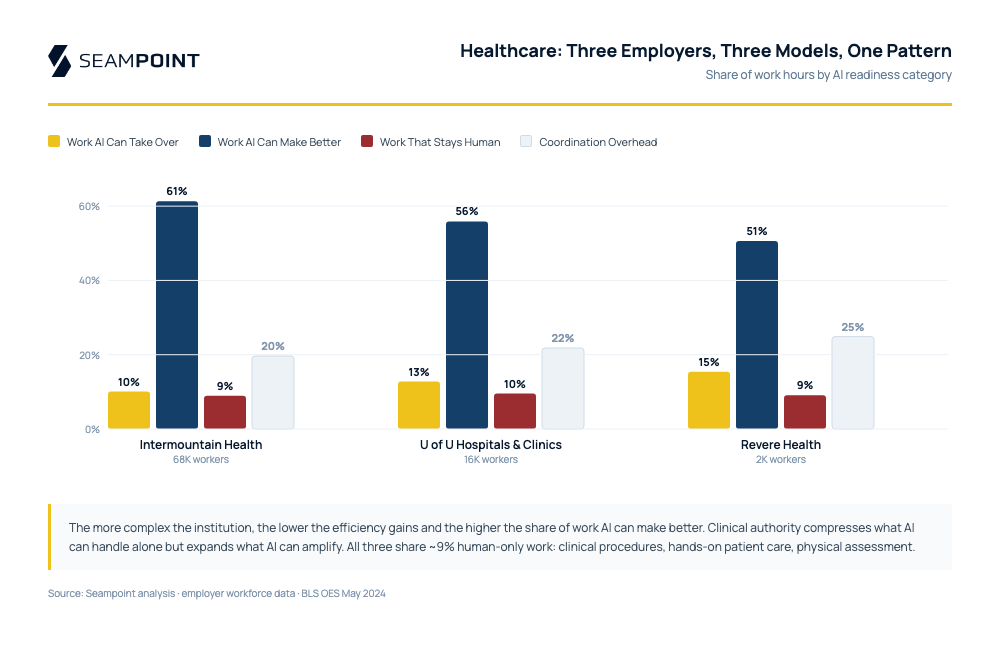
Intermountain’s 10% work that AI can take over is the lowest of the three, reflecting the sheer scale of its clinical workforce relative to its administrative infrastructure. U of U Hospitals & Clinics sits at 13%, with a larger professional services layer (4,400 in IT, finance, HR, and health plan administration) creating more work AI can take over relative to its 16,000 total. Revere Health’s 15% reflects its outpatient-heavy model: 200 receptionists, 75 contact center representatives, 100 medical secretaries. More front-desk work means more tasks that can shift to AI.
All three show about 9-10% of work that must stay with humans: clinical procedures, hands-on patient care, physical assessment. This work is structurally human.
Financial services: The teller who became an advisor
| Employer | Type | Workers | AI Can Take Over | AI Can Improve |
|---|---|---|---|---|
| Mountain America CU | Credit union | 2,600 | 22% | 59% |
| Goldman Sachs (SLC) | Investment bank | 3,000 | 16% | 59% |
| Zions Bancorporation | Regional bank | 4,200 | 15% | 64% |
Mountain America’s 22% work that AI can take over, highest among the three, reflects a branch-heavy workforce: tellers, loan servicing clerks, call center agents performing structured, verifiable transactions. As transaction processing migrates to AI, the human role shifts to relationship management, problem-solving, and financial guidance. Goldman’s lower 16% reflects a middle- and back-office workforce (operations, compliance, engineering) whose work is more judgment-intensive and harder to hand off. Zions’ 15% reflects a post-transformation technology environment where employees still manually bridge between modern systems, trapping capacity in reconciliation work.
Despite radically different business models, all three show about 60% of work that AI can improve. The proportion of financial services work where AI extends human judgment is consistent across organizational types.
Construction: The foreman who can’t be replaced by software
| Employer | Workers | AI Can Take Over | AI Can Improve | Stays Human |
|---|---|---|---|---|
| Big-D Construction | 1,900 | 9% | 71% | 1% |
| Layton Construction | 1,300 | 8% | 62% | 9% |
This sector has the lowest share of work AI can take over in the sample, lower than healthcare or professional services. You cannot yet automate the act of building a building. But 71% of Big-D’s work is the kind AI can improve: project management, estimating, scheduling, engineering, procurement. The cognitive work surrounding construction is judgment-intensive well suited to AI. An estimator using AI to model cost scenarios. A scheduler optimizing sequencing when weather shifts. A project engineer surfacing code compliance issues before they become change orders.
Layton’s higher stays-human percentage (9% vs. Big-D’s 1%) reflects a larger field operations workforce relative to its office staff. For both, coordination savings (email, reporting, scheduling) account for most of the work that can shift to AI: 72% for Layton, 58% for Big-D. Their core work is too judgment-intensive or physical to give to AI. But everyone has email.
Technology: The sector that should know better
| Employer | Type | Workers | AI Can Take Over | AI Can Improve | Stays Human |
|---|---|---|---|---|---|
| Vivint Smart Home | IoT/Services | 2,600 | 25% | 53% | 2% |
| Qualtrics | Enterprise Software | 1,400 | 18% | 58% | <1% |
| Lucid Software | Collaboration Software | 850 | 17% | 57% | <1% |
| Pluralsight | EdTech | 310 | 19% | 57% | <1% |
Utah’s technology sector shows the widest range in the sample. Vivint’s 25% of work that AI can take over, the highest of any employer we analyzed, reflects a workforce heavy on customer service and field installation support, roles with structured, verifiable tasks. Qualtrics, Lucid, and Pluralsight cluster between 17-19%, typical of software companies whose engineering-heavy workforces are already doing the kind of judgment work that AI can improve. Almost nothing about software work requires physical presence. The question for these employers is whether their engineers and product teams are learning to use AI for better judgment, not just faster output. Pluralsight’s 2025 relocation to Texas is a reminder that technology companies without geographic anchors compete on talent and capability, not location.
Defense and government: The institutions that can’t move fast and break things
| Employer | Type | Workers | AI Can Take Over | AI Can Improve | Stays Human |
|---|---|---|---|---|---|
| Federal Civilian Workforce | Defense/Military | 34,400 | 14% | 55% | 5% |
| State of Utah | State Government | 21,500 | 13% | 55% | 7% |
The two largest employers in the sample show nearly identical profiles: moderate shares of work AI can take over, more than half of all work that AI can improve, and modest shares of work that stays human, reflecting law enforcement, corrections, and military operations. The 14% and 13% figures may look unremarkable. But at this scale, 34,400 and 21,500 workers respectively, even modest percentages represent thousands of full-time positions in administrative, procurement, and correspondence work that could be redirected to mission-critical functions. The binding constraint is acquisition and compliance frameworks that govern how government agencies adopt new tools. Federal procurement cycles, federal security certifications, and state IT security policies create adoption timelines measured in years, not quarters.
Manufacturing and medical devices: Where the factory floor meets the front office
| Employer | Type | Workers | AI Can Take Over | AI Can Improve | Stays Human |
|---|---|---|---|---|---|
| BD (Becton Dickinson) | Medical Devices | 1,500 | 12% | 60% | 2% |
| Lifetime Products | Consumer Manufacturing | 1,500 | 16% | 50% | 4% |
Two manufacturers of roughly equal size, with different AI profiles. BD’s lower share of work AI can take over and higher share of judgment-intensive work reflect a workforce weighted toward quality engineers, regulatory affairs specialists, and R&D scientists, roles where FDA requirements mean AI can inform but cannot sign off. Lifetime Products’ higher share reflects more production planning, purchasing, and warehouse operations staff where structured tasks dominate. Both show low shares of work that stays human, which may seem counterintuitive for manufacturers. Modern manufacturing in Utah is increasingly automated at the machine level. The human work that remains is supervisory, engineering, and quality, all work AI can improve.
Tourism: The seasonal workforce challenge
Vail Resorts’ Park City operations (2,500 workers) show 21% of work that AI can take over, among the highest in the sample, driven by seasonal front-desk, ticketing, rental, and food service staff performing structured, high-volume transactions. The 8% stays-human share reflects ski patrol, lift operations, and snowmaking, work governed by safety regulations and physical reality. At 43%, Vail has the lowest share of work AI can improve of any employer in the sample, reflecting a workforce weighted toward entry-level service roles rather than judgment-intensive management. For Utah’s broader tourism economy (nearly 100,000 direct jobs), this profile suggests that AI’s near-term impact will be felt most in reservation systems, customer communications, and back-office operations, while the guest experience and outdoor operations that define the industry remain human.
Professional and legal services: The judgment factories
| Employer | Type | Workers | AI Can Take Over | AI Can Improve | Stays Human |
|---|---|---|---|---|---|
| Deloitte (Utah) | Professional Services | 700 | 7% | 80% | 0% |
| Kirton McConkie | Legal Services | 300 | 9% | 62% | 7% |
Deloitte’s Utah office shows the highest share of work AI can improve of any employer in the sample at 80%. Consultants, auditors, and advisory professionals do almost nothing that can simply shift directly to AI. Their work is judgment from top to bottom. The 7% that can shift is essentially coordination overhead: scheduling, correspondence, internal reporting. Kirton McConkie’s profile tells a different story. Its 62% or work AI can improve includes attorneys doing legal research, contract analysis, and case strategy, work where AI is already demonstrating value as a research accelerator. The 7% that stays human reflects courtroom work, depositions, and client representation where legal authority requires a licensed human. For both, the competitive question is identical: which professionals learn to use AI for better judgment, serving clients at a level their peers cannot match?
Real estate services: The distributed workforce
Extra Space Storage’s 1,300 Utah-based workers show 18% of work AI can take over and 57% it can improve, a profile that mirrors the financial services cluster more than the real estate sector. This reflects the company’s actual work: customer service, facility management, revenue optimization, and corporate operations. Most of Extra Space’s roughly 6,000 total employees are distributed across 3,500+ facilities in 42 states, making it an interesting test case for AI deployment at scale across a geographically dispersed workforce where local facility managers make daily operational judgments that corporate systems can inform but cannot replace.
The same job is the same job
One key insight is that susceptibility to shifting tasks to AI is a property of the job, not the employer. Software developers show the same profile whether they work at Qualtrics, Goldman Sachs, Vivint, or Lifetime Products. Customer service representatives do the same work at Mountain America, at Traeger, at Vivint. The job of registered nurse is the same at Intermountain, at U of U Hospitals & Clinics, at the Federal Civilian Workforce.
The four governance constraints operate at the task level. An organization’s industry, size, and technology maturity affect how quickly it captures the opportunity, but they don’t change what the opportunity is. For workforce policy, this means you can assess a role’s AI susceptibility without having to know who the employer is.
Part 3: What the Data Means
The bigger prize: making people better at their jobs
The work AI can take over gets all the attention. It’s concrete, measurable, immediate. At $21 billion, it’s the larger near-term dollar figure. But it has a ceiling: once you’ve shifted a task to AI, you’ve captured the gain. You can only shift a task to AI once.
The opportunity to make people better at their job tasks works differently. It touches half of all work hours, and it compounds. A financial analyst who uses AI to pressure-test an investment thesis doesn’t just save time. That analyst makes a better decision. And the better that analyst gets at working with AI, the better the decisions get. That’s a powerful compounding force. Across 51% of Utah’s work hours, even modest improvements in judgment quality repeated over time adds up to enormous economic value. That’s why making people better at their jobs is the bigger prize, even though its near-term measurable floor ($15 billion) is smaller than the $21 billion in work that can shift to AI.
Anthropic’s recent release of production data makes this concrete. Their Learning Curves report (March 2026) found that users who have been using Claude for six months or more achieve a 10% higher task success rate, an association not explained by task selection, geography, or other factors. Their behavior shifts in observable ways:
-
They delegate to AI without follow-up 9 percentage points less than new users
-
They iterate on tasks 4 points more
-
They use AI for learning 3 points more
-
They use AI for work (not personal) 7 points more
Experienced users stop treating AI as a fast assistant and start using it as a thinking partner. They iterate, challenge, refine. They get measurably better results. This takes about six months of sustained practice to develop.
This opportunity is captured by learning to work with AI rather than just handing tasks to AI. Organizations and workers who invest in building that capability now will compound those advantages. Those who wait will face a widening gap.
Where the shift hits hardest
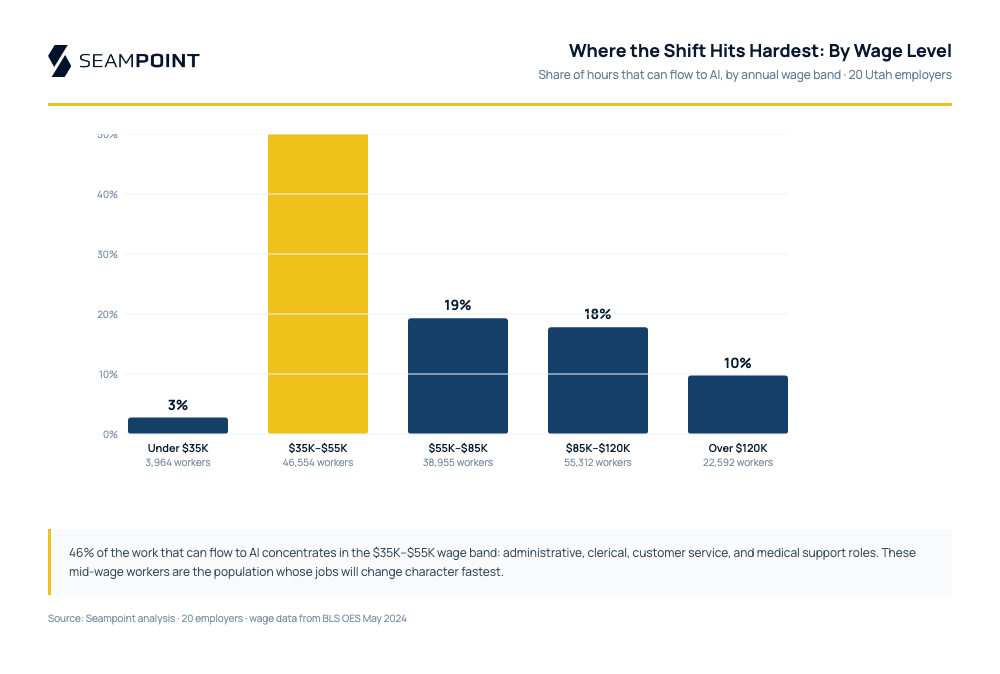
Where the work that can shift to AI concentrates by wage level
As noted in the executive summary, the work that can shift to AI concentrates in a specific wage band, and the details matter for policy. Half of all the work hours that AI can take over sit in jobs paying $35,000 to $55,000 per year: administrative, clerical, customer service, and medical support roles. Only 3% sit in the lowest-wage jobs. Only 10% in the highest. The concentration is in the middle. Workers who earn enough to have families, mortgages, and obligations, but who typically lack the professional networks and financial reserves that cushion higher-wage knowledge workers during transitions.
Some specific roles show just how concentrated the shift is. In Utah, 85% of a secretary’s work hours can flow to AI. For bookkeepers, 67%. For general office clerks, 63%. For cashiers, 58%. Seventeen occupations have more than half their hours in the takeover zone, employing 145,000 Utah workers at an average wage of $49,000. These are the roles that will change character fastest.
But “change character” is the right phrase, not “disappear.” What’s shifting to AI across all these roles is the administrative layer: recording transactions, classifying documents, completing forms, processing routine requests. Even in physical jobs like mail carriers (53%) and stockers (52%), the percentage reflects record-keeping and data entry, not the physical work itself. The carrier still walks the route. The stocker still stocks the shelves. AI absorbs the paperwork. The human role concentrates on judgment, coordination, and problem-solving. Navigating that transition requires support.
Start with coordination, not core work
Managers who start by shifting core work tasks to AI (“AI can write our marketing copy,” “AI can build our financial models”) are starting with the hardest governance problems. Managers who start by shifting coordination overhead to AI are starting where the risk is lowest, and the returns are fastest. What’s more, the organizational learning from these shifts transfers directly to the harder problems, later.
The rising generation: education at a crossroads
The traditional path into many professions runs through entry-level work that AI is now absorbing. Junior analysts build pitch decks. First-year associates review documents. Entry-level coders write boilerplate. Anthropic’s data shows hiring of workers aged 22-25 into AI-exposed occupations has slowed roughly 14% since ChatGPT’s release.
The occupations with the highest shares of work AI can improve—accountants, management analysts, health services managers, computer systems analysts (see Appendix C)—are the roles tomorrow’s graduates will fill. These roles require judgment, contextual awareness, and the ability to work with AI effectively from day one.
Utah’s educational establishment is largely in a defensive posture about AI. Understandably so. AI threatens existing assessment models: if students can use AI to produce essays and answers indistinguishable from their own work, how do you evaluate learning? This is a real challenge.
The institutions that are able to look past this assessment crisis to what lies on the other side will see an opportunity to redesign professional preparation around the skills that matter in an economy where AI makes good professionals better. That means looking beyond AI avoidance, beyond “safe AI” training, to learning how to use AI well. Learning to use AI for research. Learning to iterate rather than delegate. Learning to challenge AI output rather than accept it. Learning to develop judgment that makes a professional’s AI-amplified output worth more than what either could produce alone.
The skill gap that matters most is the one between students who learn to use AI as a shortcut and those who learn to use it as a thinking partner. Anthropic’s data demonstrates the difference: experienced users achieve 10% higher task success rates and tackle harder tasks. The institutions that develop this capability in their graduates will produce the professionals Utah’s employers actually want and start the businesses that will expand Utah’s economy in the future.
What “Pro-Human AI” looks like in practice
In December 2025, Governor Cox announced Utah’s Pro-Human AI Initiative, and the Department of Commerce Office of Artificial Intelligence Policy has made “pro-human AI” a centerpiece of the state’s technology strategy. The values are right: AI deployment should be pro-empowerment, pro-learning, pro-thinking, pro-healing, pro-human interaction. But four months in, “pro-human” remains a set of aspirations without an operational definition. When a specific employer deploys AI across specific roles affecting specific workers, how does the state determine whether that deployment is pro-human or not? What would it measure? What would it flag? Without answers to these questions, “pro-human AI” risks becoming the kind of phrase that everyone agrees with but nobody acts on.
The data in this report suggests a working definition. Pro-human AI deployment does three things…
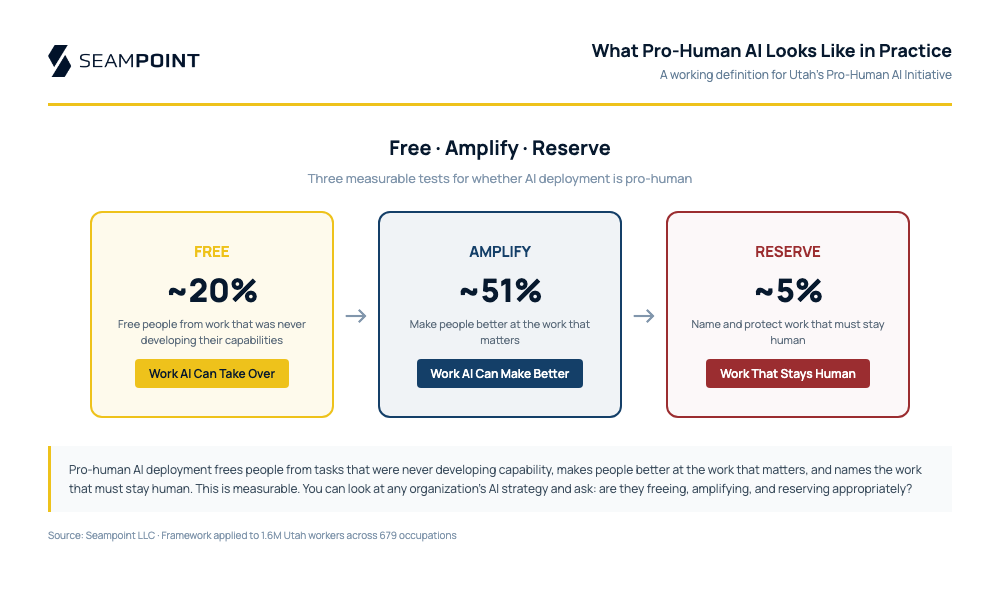
What Pro-Human AI looks like in practice
1. It frees people from work that was never developing their capabilities. The accounts payable clerk matching invoices to purchase orders is performing a high-volume reconciliation task that happens to be housed inside a human because, until recently, there was no alternative. The customer support representative answering the 200th password-reset ticket this month is not sharpening communication skills. That worker is absorbing repetitive friction that AI can now free them from. The 20% of Utah’s work hours that can flow directly to AI was never playing to human strengths. Handing it off is the precondition for pro-human deployment. You can’t empower people who are trapped doing work that a machine should be doing.
2. It makes people better at the work that matters, which is half of Utah’s work hours. When a physician uses AI to surface a differential diagnosis that might have been missed, clinical judgment carries farther. When an engineer uses AI to iterate on designs at a pace that previously required a team, architectural insight produces more impact. When a financial analyst uses AI to pressure-test an investment thesis against data that couldn’t have been assembled manually, analytical judgment reaches deeper. The quality of the output is bounded by the quality of the human input. A bad voice amplified is just a louder bad voice. A skilled professional working with AI can achieve outcomes that were previously impossible regardless of effort. This kind of AI use is inherently pro-human because it amplifies the value of human capability. Organizations that develop their people get more from it. Organizations that don’t, don’t.
3. It names the work that must stay human, and protects it. Some work is human because it must be, and naming it clearly is itself a pro-human act. When we identify the 5% of Utah’s work hours that stay with humans by design, we are telling aircraft mechanics, registered nurses, construction workers, firefighters, and correctional officers: your work requires human presence, authority, or judgment that cannot transfer to AI. This recognition counters the displacement narrative with structural facts and honors work whose value lies precisely in its human character.
A measurable standard
This three-part definition—free/amplify/reserve—offers a deployment framework that goes beyond values statements. It can be applied to any organization and measured against actual data. Is the employer freeing workers from tasks that were never developing capability, or eliminating roles without reinvestment? Is it building the capability that makes AI-enhanced judgment possible, or deploying AI as a cost-cutting tool that bypasses human judgment? Is it recognizing which work must stay human, or pushing AI into domains where the constraints exist for good reason?
Utah’s Office of Artificial Intelligence Policy has built something few states have: institutional infrastructure for thinking carefully about AI deployment. That’s a genuine advantage. But the gap between “pro-human” as a value and “pro-human” as an enforceable standard is where policy meets reality. The free/amplify/reserve framework offers one way to close that gap—connecting Governor Cox’s vision to measurable outcomes, in specific organizations, across specific roles, with specific workers whose livelihoods depend on getting it right. The data exists. The institutional infrastructure exists. What’s missing is the operational bridge between the two.
Independent Validation
Three independent data sources corroborate this analysis. Anthropic’s Economic Index, which measures real-world AI usage across 756 occupations, shows deployment patterns that broadly track our estimates—and in some roles, like software development, real-world adoption is already running ahead of our projections. Anthropic’s Learning Curves report confirmed that the ability to use AI as a thinking partner is learnable and measurable, with experienced users achieving 10% higher task success rates. And BLS employment projections through 2034 correlate with where AI is actually being used, not where it’s theoretically capable, confirming that real deployment, not theoretical exposure, is what predicts labor market shifts. (Detailed comparisons in Appendix D.)
For Utah’s Policymakers
1. The work AI can take over is not the workforce crisis. At roughly 20% of work hours statewide, the tasks that can flow to AI are more likely to change jobs than eliminate them. As AI absorbs the repetitive parts of work, the human role concentrates on the judgment parts of work. The policy response should be transition support for mid-wage workers ($35K-$55K) whose roles are changing fastest.
2. The bigger opportunity is making people better at their jobs, and Utah isn’t ready. About half of Utah’s work is in roles where AI has the power to extend human judgment. Capturing this value requires learned capability that takes months to develop. Utah’s workforce infrastructure—Talent Ready for students, UVU’s apprenticeship pipeline—doesn’t yet have an equivalent for the existing workforce. The state that builds this bridge first will have a structural advantage.
3. Track whether AI is making people better, not just whether it’s replacing tasks. The policy conversation focuses on jobs at risk from AI displacement. It should also measure whether Utah’s workers are developing the capability to use AI for better judgment. Are employers investing in building that capability? Are workers shifting from delegation to iteration? The behavioral markers are observable. Anthropic’s data provides the template.
4. Utah’s job anchors are real and structural. The same constraints that slow AI deployment (clinical authority, physical reality, security requirements, legal accountability) also anchor jobs geographically. Hill Air Force Base, Intermountain Health, the construction trades, public safety: these employers and this work are staying. This is worth communicating to a workforce anxious about displacement.
5. Condition incentives on reinvestment, not just efficiency. When AI frees capacity, the question is what happens next. Organizations that reinvest freed capacity into expansion create new jobs. Organizations that treat AI purely as cost-cutting will cut costs and headcount. Economic development incentives should be calibrated to promote the former and discourage the latter.
Methodology
This analysis applies the Seampoint AI Readiness℠ methodology at two levels:
State-level: Utah employment and wage data from Bureau of Labor Statistics Occupational Employment and Wage Statistics (May 2024), matched to national AI readiness profiles at the 6-digit SOC code level. 679 of 848 national occupations matched to Utah employment data.
Employer-level: 20 Utah employers analyzed through two data sources: BLS OES Research Estimates (Federal and State Government) and AI-assisted workforce profiling based on named public sources. All processed through the same deterministic calculation engine using pre-computed governance coefficients for 848 SOC codes. Multi-state employers adjusted to Utah-based workforce only.
The AI readiness coefficients were derived from a multi-model evaluation panel—four frontier AI models independently assessed 18,898 tasks from the O*NET occupational database against the four governance constraints (consequence of error, verification cost, accountability requirements, and physical reality). The models showed high agreement with each other (Fleiss’ Kappa 0.81), indicating that the assessments are consistent and reproducible rather than dependent on any single model’s judgment.
Limitations. Employer workforce profiles for private-sector companies are estimates based on public data because verified HR records are not generally available. National governance coefficients are applied to Utah-specific roles. The employer sample (10% of Utah’s workforce) is illustrative rather than statistically representative, with stronger coverage in healthcare and defense than in manufacturing, construction, and tourism.
About This Research
This report extends The Distillation of Work (© Seampoint, January 2026), which analyzed AI’s impact on 148 million U.S. workers at the national level. That analysis used three fictional employer profiles to illustrate sector patterns. This report replaces fiction with fact: 20 real Utah employers using the same methodology.
The full dataset, state-level occupational analysis, 20 employers, 1,112 role records, is maintained in a queryable database available to qualified research partners.
Suggested Citation: Seampoint LLC. (2026). Utah’s AI Workforce Reality: What 1.6 Million Workers and 20 Employers Tell Us About What’s Coming.
We welcome collaboration with Utah employers, state agencies, and educational institutions. Contact research@seampoint.com.
Seampoint is a research and advisory firm focused on the boundaries where human authority meets AI capability. We help organizations identify where AI deployment is appropriate, design for safe delegation, and build the workforce capability to get more from AI—not just faster work, but better judgment.
Data Appendix
A. Utah’s Workforce by Occupation Cluster
| Cluster | Workers | AI Can Take Over | AI Can Improve | Stays Human | Coord. Overhead | Total AI Opportunity |
|---|---|---|---|---|---|---|
| Office & Administrative Support | 229,310 | 45% | 33% | 0% | 22% | 55% |
| Sales & Related | 136,450 | 35% | 40% | 0% | 26% | 46% |
| Transportation & Material Moving | 133,010 | 23% | 35% | 11% | 31% | 33% |
| Food Preparation & Serving | 132,960 | 30% | 40% | 0% | 21% | 42% |
| Management | 122,340 | 6% | 76% | 1% | 17% | 28% |
| Construction & Extraction | 110,800 | 6% | 52% | 20% | 22% | 21% |
| Business & Financial Operations | 110,100 | 11% | 71% | 0% | 18% | 31% |
| Education | 98,960 | 16% | 57% | 1% | 26% | 32% |
| Production | 84,970 | 12% | 63% | 3% | 22% | 30% |
| Healthcare Practitioners | 76,770 | 7% | 57% | 13% | 23% | 23% |
| Computer & Mathematical | 71,530 | 20% | 56% | 0% | 23% | 37% |
| Installation, Maintenance, Repair | 66,580 | 7% | 60% | 9% | 24% | 24% |
| Protective Service | 26,310 | 6% | 37% | 32% | 24% | 17% |
How to read this table: “AI Can Take Over” shows the share of work hours in each cluster that can transfer directly to AI—structured tasks where checking AI output is cheap and mistakes are manageable. “AI Can Improve” shows the share where AI extends human judgment but can’t replace it. “Stays Human” is where physics, law, or the nature of the service requires a human. “Total AI Opportunity” combines the full takeover gains with the estimated near-term productivity improvement from AI-improved work (roughly 28-30% of those hours). This is why the columns don’t simply add up. The total reflects the economic value of both types of AI impact, not just the share of hours in each category.
B. 20 Utah Employers
| Employer | Sector | Workers | AI Can Take Over | AI Can Improve | Stays Human | Coord. Overhead | Total Opportunity |
|---|---|---|---|---|---|---|---|
| Intermountain Health | Healthcare | 68,000 | 10% | 61% | 9% | 20% | 27% |
| Federal Civilian Workforce | Defense | 34,400 | 14% | 55% | 5% | 26% | 30% |
| State of Utah | Government | 21,500 | 13% | 55% | 7% | 25% | 29% |
| U of U Hospitals & Clinics | Healthcare | 16,000 | 13% | 56% | 10% | 22% | 29% |
| Zions Bancorporation | Financial Services | 4,200 | 15% | 64% | 1% | 21% | 33% |
| Goldman Sachs (SLC) | Financial Services | 3,000 | 16% | 59% | 2% | 24% | 33% |
| Vivint Smart Home | Technology/ Services |
2,600 | 25% | 53% | 2% | 20% | 41% |
| Mountain America CU | Financial Services | 2,600 | 22% | 59% | <1% | 19% | 39% |
| Vail Resorts (Park City) | Tourism | 2,500 | 21% | 43% | 8% | 29% | 33% |
| Revere Health | Healthcare | 2,300 | 15% | 51% | 9% | 25% | 30% |
| Big-D Construction | Construction | 1,900 | 9% | 71% | 1% | 20% | 29% |
| BD (Becton Dickinson) | Medical Devices | 1,500 | 12% | 60% | 2% | 27% | 29% |
| Lifetime Products | Manufacturing | 1,500 | 16% | 50% | 4% | 30% | 31% |
| Qualtrics | Technology | 1,400 | 18% | 58% | <1% | 25% | 34% |
| Layton Construction | Construction | 1,300 | 8% | 62% | 9% | 22% | 25% |
| Extra Space Storage | Real Estate/Services | 1,300 | 18% | 57% | 1% | 24% | 35% |
| Lucid Software | Technology | 850 | 17% | 57% | <1% | 25% | 34% |
| Deloitte (Utah) | Professional Services | 700 | 7% | 80% | 0% | 13% | 30% |
| Pluralsight | Technology | 310 | 19% | 57% | <1% | 24% | 36% |
| Kirton McConkie | Legal Services | 300 | 9% | 62% | 7% | 22% | 26% |
C. Selected Occupation-Level Detail
The following occupations show the highest shares of work that AI can improve in our Utah analysis. These are the roles where AI most extends human judgment, and where the ability to use AI effectively will matter most for professional competitiveness.
| Occupation | AI Can Improve | AI Can Take Over | Total AI Opportunity |
|---|---|---|---|
| Accountants & Auditors | 92% | 4% | 31% |
| Management Analysts | 79% | 8% | 31% |
| Health Services Managers | 76% | 7% | 29% |
| Computer Systems Analysts | 76% | 12% | 35% |
D. Utah Occupations Where More Than Half of Work Can Shift to AI
17 occupations with 500+ Utah employees where more than 50% of work hours can flow to AI. These 145,000 workers (8.9% of Utah’s workforce) face the most significant role changes. Average wage: $49,000.
| Occupation | Utah Workers | AI Can Take Over | Avg. Wage |
|---|---|---|---|
| Secretaries & Admin Assistants | 14,910 | 85% | $45,100 |
| Mail Clerks & Mail Machine Operators | 790 | 71% | $43,200 |
| File Clerks | 580 | 70% | $40,600 |
| Graphic Designers | 3,070 | 68% | $62,600 |
| Bookkeepers & Auditing Clerks | 13,980 | 67% | $50,200 |
| Counter & Rental Clerks | 3,370 | 66% | $41,300 |
| Postal Service Clerks | 640 | 64% | $59,900 |
| General Office Clerks | 36,950 | 63% | $44,300 |
| Library Assistants, Clerical | 830 | 60% | $33,900 |
| Cashiers | 27,810 | 58% | $31,600 |
| Payroll & Timekeeping Clerks | 1,530 | 56% | $55,000 |
| Data Entry Keyers | 2,430 | 56% | $45,100 |
| Order Clerks | 840 | 55% | $43,200 |
| Postal Service Mail Carriers | 2,430 | 53% | $60,300 |
| Executive Assistants | 6,960 | 52% | $60,100 |
| Stockers & Order Fillers | 26,990 | 52% | $38,400 |
| Technical Writers | 620 | 51% | $80,400 |
What’s shifting in these roles? Across all 17 occupations, the work that flows to AI is the administrative component: recording transactions, classifying documents, completing forms, logging data, processing routine requests. Even in physical jobs like mail carriers (53%) and stockers (52%), the takeover percentage reflects record-keeping, counting, and data entry, not the physical work itself. The carrier still walks the route. The stocker still operates the forklift. AI absorbs the paperwork that surrounds the physical job.
E. Independent Validation
This analysis draws support from three independent sources.
Anthropic’s Economic Index measured Claude usage across 756 occupations. Their deployment data shows real-world AI usage that broadly tracks our estimates, landing at or near our Total AI Opportunity figures for many occupations. Examples: customer service representatives (our estimate 71%, Anthropic observed 70%), database architects (our estimate 56%, observed 58%). For some occupations like computer programmers (our estimate 67%, Anthropic observed 75%), real-world usage already exceeds our estimates—suggesting that in software-heavy roles, adoption is running ahead of even our projected opportunity.
Anthropic’s Learning Curves confirmed that the ability to use AI as a thinking partner is learnable and measurable. The behavioral shift from delegation to collaboration is observable in production data and correlates with better outcomes.
BLS employment projections through 2034 correlate with Anthropic’s observed deployment coverage, not with theoretical AI exposure. Jobs where AI is actually being used are the ones projected to grow less. Theoretical capability alone shows no such correlation. What’s happening in practice predicts labor market shifts. What’s possible in theory does not.
Where does AI belong in your processes?
Let us map the AI opportunities in your organization today.