
Services
From Diagnosis to Deployment
We diagnose before we prescribe.
We design before anyone builds.
We work with organizations at every stage of AI adoption, from leaders who haven't started yet to teams mid-deployment who've hit a wall. Some clients engage us for a single diagnostic. Others work with us from initial assessment through AI integration implementation oversight. The shape of the engagement depends on where you are and what you need.

Our Services
A typical engagement
Seampoint Map
The diagnostic that tells you where to focus.
We assess your people, products, processes, and systems against our four governance constraints: Consequence of Error, Verification Cost, Accountability Requirements, and Physical Reality, to produce a prioritized map of current AI uplift opportunities as well as identifying where human involvement and oversight remains critical.
Capacity Map and Priority Ranking you can act on immediately.
Discovery
The foundation everything else is built on.
A 6–8 week diagnostic engagement where we interview your people, map your processes and systems, and analyze where cognitive capacity is trapped across your organization. For each person we interview, you receive a complete picture of their work: responsibilities, workflow diagrams, and a classification of the AI opportunities for every significant task by delegation category.
Master Workflow Map and Process Summary with prioritized recommendations.
AI Operator Training
Fluency, not just proficiency.
We typically start with your senior executive team building the intuition leaders need to govern and direct AI initiatives. From there, training cascades through four additional tiers: equipping managers to lead their teams through agent-specific workflow changes, building installed fluency for individual contributors, and delivering just-in-time technical training as specific AI agents go live.
Customized AI Curriculum and Analysis Playbook for internal replication.
Seam Design
Implementation-ready specifications, not strategy decks.
For each prioritized AI integration opportunity, we produce a complete specification covering both sides of the seam: what the AI system needs to do AND how the surrounding SOPs, roles, and oversight need to change. The output is fully executable. When you hand it to a vendor or internal team, they know exactly what to build. We don't build it ourselves but we help hold the execution accountable to the required governance.
Seam Design spec with technical requirements, process redesign, and risk register.
Implementation Oversight
Protecting design integrity through deployment.
We write the RFP, advise on vendor selection, and provide overwatch through deployment. When implementation drifts from the specification, we catch it early. We don't deliver implementations ourselves so when we flag a problem, it's because the design is at risk, not because we're protecting our own scope.
Vendor Requirements Document, evaluation criteria, and deployment monitoring.
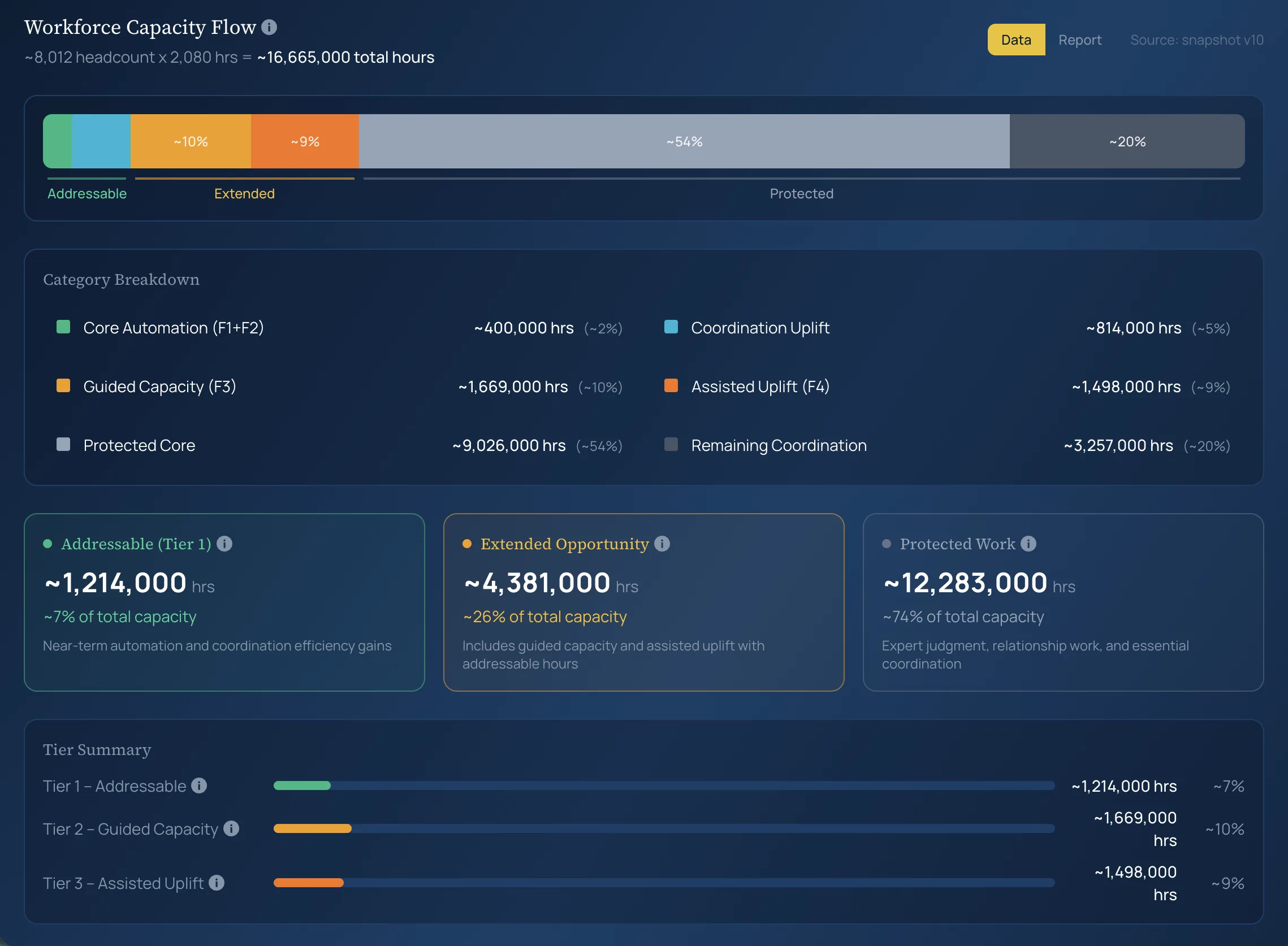
Sample Seampoint Map header — tap image to open full size
Our Approach
How we're different
We build your capability, not your dependency
Every engagement produces documentation you own and can reference. We transfer skills so you build internal capability.
We stay unconflicted
We don't build systems, sell software, or take referral fees from vendors. When we recommend something, it's because it's right for you.
We do the diagnostic work
Discovery is not optional. The organizations that succeed with AI are the ones that understand their work before they change it.
We produce artifacts, not advice
Every service produces concrete deliverables: documents, diagrams, specifications, and curricula that you can use after we're gone.
The Challenge
The problems with most AI initiatives
Organizations often approach AI adoption in one of two ways. Either they chase AI apps and tools by deploying chatbots, copilots, and automation platforms without understanding where they'll actually create value. Or they only use AI to do searches and draft emails and put off building AI into their actual systems, paralyzed by uncertainty about what it might do.
Both approaches fail. Tool-first thinking creates expensive experiments that don't compound into capability. Waiting to integrate AI into your core systems creates competitive exposure as peers move first and hampers an organization's ability to keep up with new AI capabilities as they evolve.
The organizations that succeed are the ones that understand their work deeply enough to know exactly where AI creates leverage now, where human judgment must remain, and where the processes of work can be refactored to deliver value in new ways moving forward.
Where does AI belong in your processes?
Let us map the AI opportunities in your organization today.