Why Companies Are Deploying AI Agents Backwards

Jeff Whatcott · May 12, 2026
When I observe firms deploying AI agents I often end up researching the pitches of their vendors. What I’m seeing is backwards, and it’s creating an unstable situation that will not endure.
Firms are ingesting AI agents from two push channels at once. Incumbent software platforms are adding agentic features to their existing products. Startups are pitching standalone agents or agent suites. The offers sound different, but the sequencing problem is the same: the agent arrives before the requirement. Buyers are dazzled by solutions to problems they either don’t know they have or haven’t examined enough to prioritize.
As problems from this sequencing error start to fester, a third category of vendors enters the scene: agent supervision platforms. They pitch control planes, safety layers, token cost controls, and audit trails that they insist must become a top priority. These are solutions to real problems. But the boom in this category reveals something more important than the category itself: firms are trying to govern agentic AI deployment decisions they didn’t make themselves, decisions that were silently imposed by their vendors.
AI agents do need runtime governance because they are entropic systems. But the problem right now is that distribution is deciding architecture. If an AI agent finds you before the requirement does, as a startup pitch or as a “free” new feature of a trusted platform, the right response is to slow down and do the requirements analysis instead of jumping into premature adoption.
The correct sequence for deploying a capable but somewhat unpredictable system is straightforward:
- define the job to be done
- define the authority
- define the consequence of failure
- define the escalation triggers
- then deploy
That’s how we onboard people into sensitive roles. It’s how we introduce new software into production. It’s how we manage any system that can do real damage.
But the current agentic AI pattern runs in reverse…
- Turn the agent on
- Watch what it does
- Add policies, approval gates, and logging after the fact
Governance is being retrofitted onto observed behavior instead of being derived from the requirements of the business processes in question.
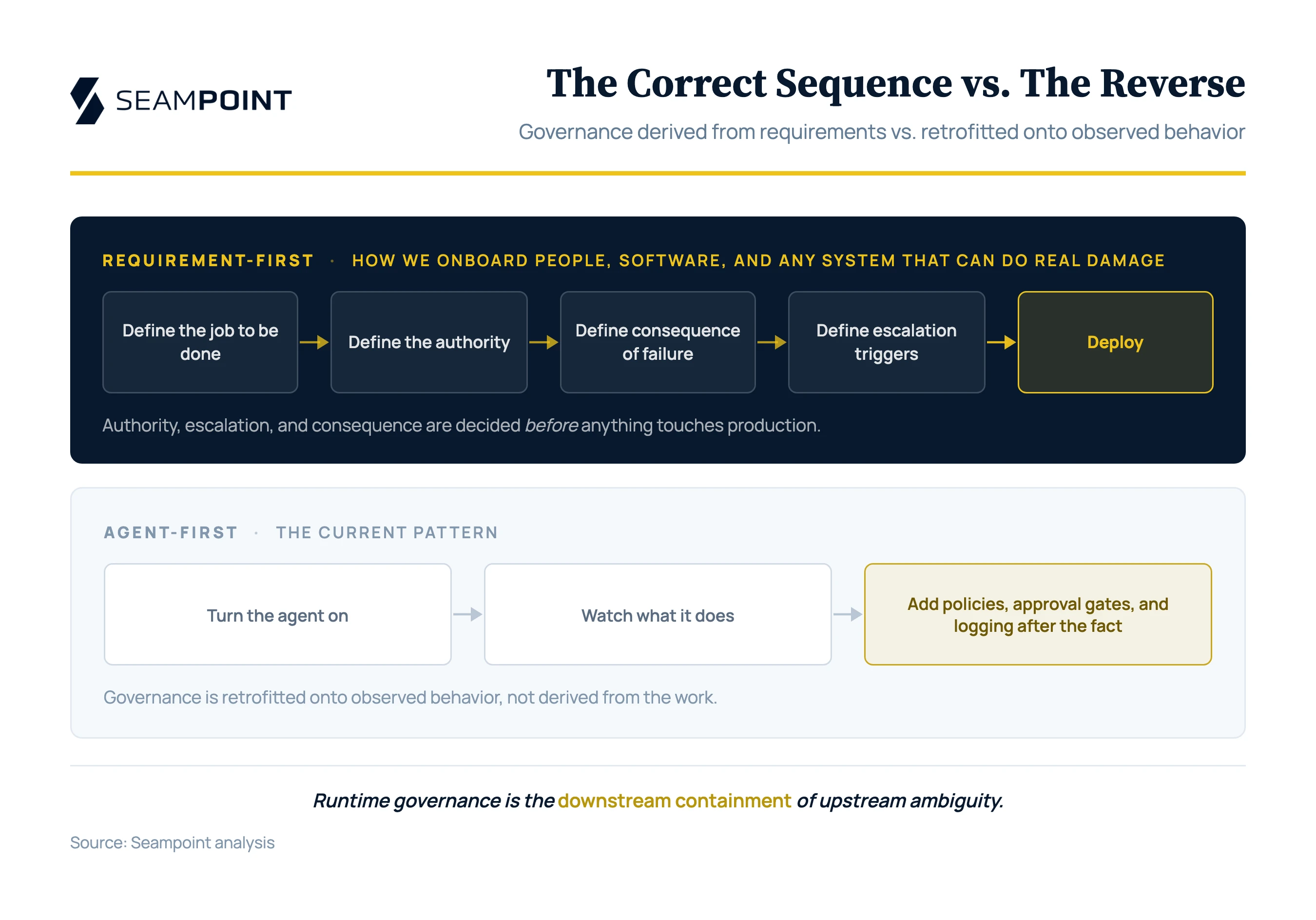
The Anti-patterns of Poor AI Architecture
Runtime governance and design do different jobs. A control plane can log actions, enforce policies, cap spending, require approvals, and help with incident reviews. But it cannot answer the questions that come before all that: Should this workflow be delegated at all? At what consequence tier? With what human accountability? And against what definition of acceptable failure?
Firms that didn’t start there are buying the downstream containment of upstream ambiguity. The anti-patterns are easy to spot once you know what to look for.
The first is capability-first reasoning, where organizations start with “this agent can do X” and work backward to “where is X in our operation.” If the demo is where you discovered you have a problem, it might not be a problem at all. The tool’s capability is defining the scope rather than the structure of the work.
The second is speed pressure. Boards and executives want visible AI adoption now. Turning on a “free” feature or piloting a vendor agent takes minutes. Figuring out which tasks, at which authority levels, with which escalation paths, takes longer. A thick layer of runtime governance makes the shortcut feel responsible. But the steps it skips are there for a reason.
The third is unsolicited agent pitches. The startup that shows up saying “our agent can automate your invoice reconciliation” has already chosen the task, the surface, and the implied governance level, all based on assumptions about your operation that may not hold. The vendor picked the lock they have a key for. What if your lock is different?
The fourth, and most interesting, is bundled platform features. The agent doesn’t arrive as a separate buying decision at all. It arrives as a feature inside software the firm already uses. That makes scrutiny less likely, not more. Buyers mistake bundled for free, and free for low-risk. But the operational risk lives in the workflow, not the SKU. A “free” AI feature inside a system of record can be more consequential than a standalone tool precisely because it already sits next to real data and has real permissions on live processes.
What to Do Instead
If any of this seems familiar, the remedy is to hit pause on deployment and gather the facts. Start from the work to be done, not from the agent capabilities. Break the process into tasks. Ask which actor should be assigned given the consequences of error and the cost of appropriate verification.
The output of that analysis goes beyond a vague sense that “AI can help” to a set of concrete requirements:
- a delegation boundary for each task (autonomous, human-reviewed, or never delegated)
- an authority map defining what systems, data, and actions the agent can touch
- escalation triggers for uncertainty, exception classes, policy conflicts, and spend thresholds
- and a verification model covering deterministic checks, sampling, audit trails, and incident handling.
Having these requirements in hand equips you to evaluate vendor pitches and bundled features alike. Until you have consensus on clear answers, the right default is to stay paused.
None of this is to say that control planes are useless or that runtime supervision doesn’t matter. Policy enforcement, cost controls, approvals, auditability, and forensic trails are real capabilities for real runtime risks. Mature organizations need them for people, software, and agents alike.
But runtime governance is the downstream governance problem. The upstream problem is deciding where an agent belongs, what authority it should hold, and what level of consequence the firm is willing to accept before anything touches production. Some of the current spending on control planes is necessary. Some of it exists because deployment happened in the wrong order; a governance tax on skipped analysis.
The conventional wisdom says the adult move is to deploy agents with a strong control plane watching them. That is only half right. The adult move is to decide where the agent belongs before it shows up, whether it arrives as a startup pitch, an enterprise platform feature, or a line item in next year’s budget. Runtime governance matters. But it cannot answer the question that determines whether the deployment makes sense in the first place.
The agent that finds you still needs a leash. The agent you deliberately design will need one too. But before either of them gets a leash, they need a job description. If the agent finds you before the requirement does, don’t turn it on.
More to read

A Tale of Three AI Cars
Three self-driving philosophies from Subaru, Waymo, and Tesla reveal what happens when AI gets confused—and why operating protocols matter more.
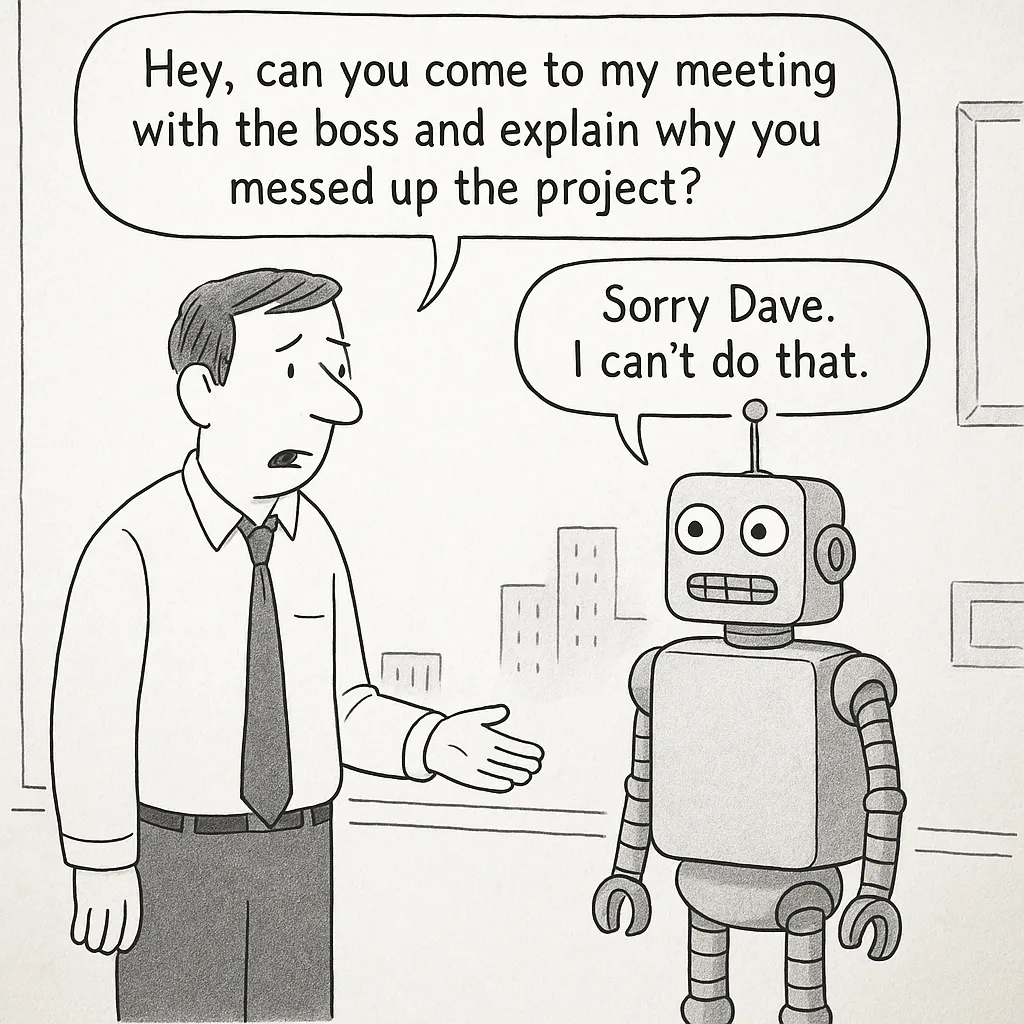
Refactoring Agents
What building agentic AI systems teaches about the overlap between software architecture and workforce design—and why the AI employee metaphor fails.
Speed Is a Trap: Autonomous AI Defense
Armadin promises autonomous cybersecurity, but removing humans from the loop breaks accountability before it breaks hackers. Why speed alone is a trap.
Where does AI belong in your processes?
Let us map the AI opportunities in your organization today.
Start a conversation