Speed Is a Trap: Autonomous AI Defense
Alan Berrey · December 19, 2025
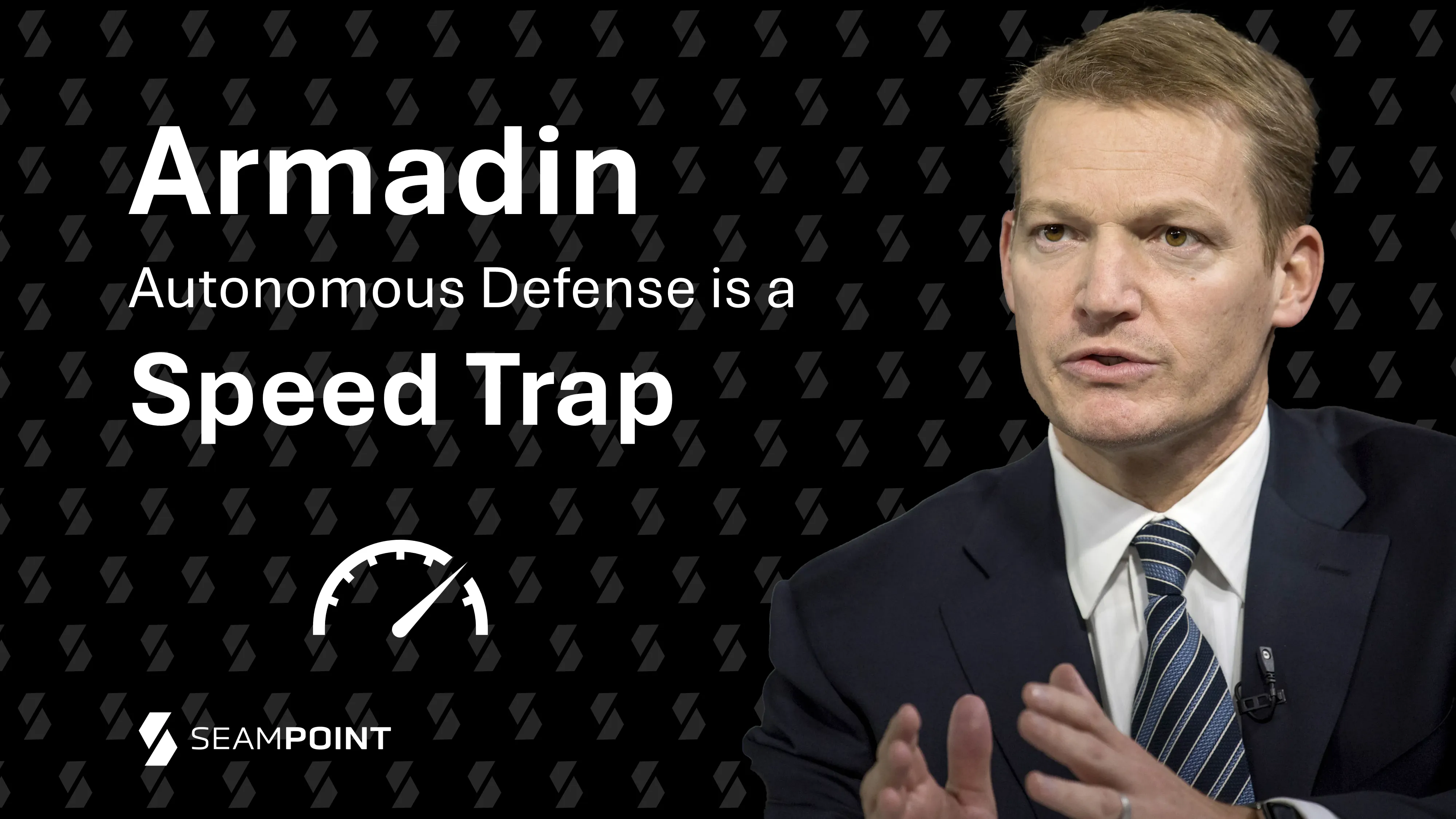
Kevin Mandia is a giant in this industry, so when he says the sky is falling, people listen, and VCs open their checkbooks. His new play, Armadin, is coming out of the gate with a reported $600 million target valuation based on a simple, terrifying premise: hackers are moving at the speed of AI, so our defenses must be fully autonomous.
“You can’t have a human in the loop,” Mandia told the Wall Street Journal, “or it’s going to be too slow.”
It is a great soundbite. It is also a direct path to a corporate catastrophe.
Armadin is obsessed with one truth while ignoring two others. Yes, humans have a biological speed limit. We cannot triage a thousand alerts in a millisecond. That is the Scale problem, and Mandia is right that AI must solve it. But scaling speed without scaling judgment is how you blow up a company from the inside.
The Probability Problem
Here is the uncomfortable reality: AI does not “know” things. It predicts them. It is fundamentally probabilistic.
An AI defender is always making a guess based on patterns. If that system is 99 percent accurate, it sounds impressive until you realize what that means in a high-volume enterprise environment. At scale, a one percent error rate is not a possibility, it is a mathematical certainty.
When an autonomous system guesses wrong and decides to defend the network by shutting down a primary payment gateway or wiping a “suspicious” but critical database, the defense becomes the disaster. You have not stopped an attacker. You have automated a self-inflicted amputation.
The Accountability Gap
This leads to the accountability threshold, the question every CTO, CISO, and board ultimately asks.
Who gets fired when the AI makes a catastrophic mistake?
You cannot put an algorithm on a performance improvement plan. You cannot cross-examine it in front of a regulator. And you certainly cannot sue it for professional malpractice.
In a regulated enterprise, every irreversible action must map to a named executive, an audit trail, and an insurance policy. Accountability is a human burden. It requires a human signature on the decisions that can materially harm customers, shareholders, and the business itself.
No responsible leadership team is going to hand the keys to the kingdom to a black box with no moral agency, no legal standing, and no career consequences when it gets it wrong.
Finding the Seam
Armadin has some of the brightest minds in the world, and they will likely confront this reality as the hype cycle cools. The winning strategy in cyber defense is not all-AI or all-human. It is finding the seam where machine speed meets human judgment.
Machines for execution. Let AI autonomously handle reversible actions: blocking IPs, isolating individual laptops, triaging noise, and containing blast radius.
Humans for authority. Keep people in charge of systemic, high-consequence decisions: shutting down platforms, deleting data, or taking actions that define the company’s survival.
If Armadin continues to preach total autonomy, adoption will stall, not because the technology is insufficiently fast, but because no executive will accept personal accountability for an irreversible decision made by a machine.
Why This Matters
The value of Armadin, like the value of every AI solution, is not determined solely by the capabilities of the technology. It is realized at the Seampoint between human and machine. In this case, that seam sits at the intersection of scale, judgment, and accountability. That line is where trust lives. And without trust, speed is not a competitive advantage. It is a liability.
Kevin Mandia is General Partner at Ballistic Ventures (Bio, LinkedIn)
More to read

The AI-Beats-Doctors Study Didn't Measure ER Medicine
A retrospective text-only experiment ran on AI's home court. The headlines treated it like a clinical trial.
Refactoring Agents
What building agentic AI systems teaches about the overlap between software architecture and workforce design—and why the AI employee metaphor fails.

AI is Redefining Expertise
AI is compressing the gap between knowledge and judgment. How to manage the seam between the speed of AI and the irreplaceable wisdom of the SME.
Where does AI belong in your processes?
Let us map the AI opportunities in your organization today.
Start a conversation