AI is Redefining Expertise

Alan Berrey · December 11, 2025
For centuries, leaders have turned to experts when decisions were important or the stakes were high. Nearly 2,500 years ago, Socrates observed that “when a decision has to be taken at the state… they send for experts.” His point was simple: no matter how wealthy, charming, or well-born a person may be, expertise (not status) guides important decisions.
Throughout history, this pattern has held. Monarchs consulted strategists and scholars. Industrialists relied on engineers and chemists. Modern executives built entire organizations around subject matter experts (SMEs) who shaped decisions in war and peace, law and trade, medicine, transportation, communications, and more.
Experts held political, economic, and social power because they possessed knowledge others could not access. Today, that access advantage is eroding. Expertise is still valuable, but AI puts expertise into the hands of the masses. AI can now retrieve and synthesize information faster than any human ever could.
This shift does not diminish the value of the experts, but it does relocate it. Expert value now concentrates at critical decision thresholds where judgment, ethics, and accountability cannot be delegated. Understanding where these thresholds lie, and where they do not, is essential for organizations trying to work well with AI.
The Demand for Zero-Friction Knowledge
Modern organizations operate at a pace that leaves little room for reflection. Leaders juggle competing priorities, rapid meetings, and rising expectations. Decision fatigue is common, and attention is fractured.
In this environment, leaders want ideas, clarity, and direction as quickly as possible. This is not impatience. It is a rational response to overwhelming workloads. Leaders need a fast way to move from uncertainty to action, especially when the cost of slowing down is high.
Subject matter experts do not operate at this pace. Their work requires context, time, and careful questioning. This friction protects the organization, but it can feel costly when momentum is the priority. AI provides the opposite experience. It is immediate, always available, and requires no preparation. Leaders can ask a question, receive a polished answer, and move on. The interaction is private and carries no social cost.
Because AI provides fast responses with minimal friction, it has naturally become the first stop for many leaders. It is not that experts have lost relevance, it is simply that AI is easier to access in the earliest moments of exploration.
While AI delivers speed, SMEs deliver depth. But in high-pressure environments, the search for speed often wins the opening move.
Experts Require Friction
Real expertise is not transactional. It is relational. A genuine expert does more than supply information: they engage with people, understand the context, and evaluate implications. This creates a different type of interaction, one that naturally introduces friction.
An expert will ask questions a leader has not considered. These questions may feel inconvenient at the moment, but they reveal hidden assumptions, missing data, and gaps in understanding. Leaders often discover that the question behind the question is more important than the answer they originally sought.
Experts push back on flawed assumptions and surface risks early, before they grow into larger problems.
AI tools often provide beautifully simple answers, but reality is rarely simple. So SMEs resist oversimplification. Experts bring nuance, history, and organizational memory. They remind leaders that the easiest answer is not always the safest or most advantageous.
AI may answer your questions, but true experts will question your answers. This distinction is critical. AI provides confidence and momentum, but it does not evaluate whether the direction is sound. Experts take on that responsibility.
Experts have not lost value, but they are being repositioned. Their work now occurs at the point where wisdom matters most: not at the opening salvo, but when decisions start to matter.
The Seam of AI and SME: Judgment vs. Knowledge
SME value is not disappearing, it is shifting. Their importance is moving from the domain of knowing, toward the domain of governance and context. AI now delivers scale, speed, pattern recognition, and precision at a level no human can match. The human, by contrast, retains authority. Judgment, consequence, and accountability should still remain firmly in an expert’s hands. This is the new division of labor, and it defines the seam where AI ends and expert responsibility begins.
The first step in understanding this shift is to acknowledge a difficult truth: the business value of simply “knowing an answer” has moved from knowledge-holding to judgment-making. AI can access and reorganize the collective knowledge of a company in seconds. A single prompt can search a thousand documents, extract insights, and return summaries that previously required hours of SME effort. The advantage once held by the person with the most information is now held by the system that can process the most information. And that system is ostensibly now available to anyone in the organization.
Many organizations are beginning to recognize this shift. AI excels at retrieval, synthesis, and pattern-matching at scales no human can reach. It can, for example, process thousands of internal documents to identify themes or pinpoint relevant precedents. It can provide near-perfect recall. It is capable of retrieving fifty thousand specific facts without hesitation. It has endless endurance. It can monitor mission-critical systems continually, day and night, without fatigue or distraction. It is built to manage complexity that overwhelms human cognition. In well-defined analytical tasks, AI often delivers results faster than any human alternatives.
But this efficiency does not make AI more accurate in all circumstances, particularly in situations where accuracy depends on causal reasoning, contextual judgment, or interpretation of ambiguous signals. AI can be spectacularly wrong with high confidence, and this risk is fundamentally different from the slower, more qualified judgments that experts offer.
Defining the Distinction
Before we can understand where expert value concentrates, we need clarity on a set of terms that often get blurred together. Knowledge is factual information. It answers what happened, what is true, and what the data shows. AI is built for this domain. It retrieves, reorganizes, and summarizes information very quickly.
Expertise is something different. It is contextual understanding, built over years of experience, that connects facts to patterns, constraints, and implications. Expertise recognizes when a rule applies, when it does not, and what lies beneath the surface of a problem.
Judgment is different still. It is the application of expertise under real conditions of uncertainty, tradeoff, and consequence. Judgment requires weighing values, interpreting ambiguity, and accepting responsibility for the outcome. It cannot be separated from the person who exercises it because the decision-maker carries the reputational and organizational stakes.
AI can accelerate access to knowledge and even approximate parts of expertise, but it cannot exercise judgment. It has no stakes, no consequences, no moral commitments, and no accountability. This is where the line must be drawn.
The decision points of where someone must accept responsibility for the outcome form what we at Seampoint call Authority Thresholds. They mark the seam where AI ends and human judgment must begin. And it is at these thresholds that expert value now concentrates, as outlined in the four areas that follow.
The Irreplaceable Four
The Authority Thresholds of AI define the zone that AI cannot or should not cross no matter how advanced it becomes. These thresholds outline the moments when human judgment is indispensable.
Consequence: Understanding Stakes
Experts must evaluate consequences in a way AI cannot. While AI can generate options, it has no lived experience of what is at risk. It cannot feel the weight of a wrong decision, nor can it intuit the cascading effects that follow. SMEs understand what is truly at stake: safety, legal exposure, mission integrity, brand reputation, and in many cases human well-being. This sensitivity to consequence shapes decisions in ways an algorithm cannot replicate.
Judgment: Ethical and Moral Considerations
Experts bring ethical, moral, and policy judgment to the table. AI has no intrinsic sense of right, fairness, or duty. It cannot weigh competing goods or navigate the tradeoffs that appear in moments of ambiguity. When a decision carries moral, political, or cultural implications, AI can supply information, but it cannot choose what is just, responsible, or aligned with organizational values. Only a human can do that.
Connection: Understanding Human Needs and Relationships
Experts understand people. They have insight into trust, motivation, conflict, history, and the informal dynamics that shape real organizational behavior. AI can model patterns, but it cannot feel the temperature in a room or sense when a team is fatigued, threatened, or inspired. Decisions involving relationships, influence, persuasion, or human needs require a level of emotional and social intelligence that remains uniquely human.
Reliability: Novel Training Data and Innovation
Finally, experts remain essential for reliability in areas where AI lacks grounding. AI can analyze existing data, but it cannot validate new realities that fall outside its training set. It cannot authoritatively judge emerging risks, novel technologies, inventive strategies, or situations with no precedent. SMEs serve as the source of new knowledge, new patterns, and new insights. They anchor innovation in reality and ensure that the organization is not misled by AI outputs that are confident but untested.
The Paradox: Experts Feel Demoted, but Their Role Is Elevated
Since the days of Socrates, knowledge has moved through a familiar path: master → practitioner → novice. Expertise shaped the foundation, the direction, and the final decision. Today, the flow has changed. Ideas now begin with the crowd. With the help of AI, the non-expert can generate endless plausible possibilities. Experts therefore serve as curators who determine what is sound, safe, and meaningful. Teams then carry the refined direction into implementation.
In theory, this shift elevates experts because they remain close to the final decisions while spending less time on trivial details or questions. Organizations rely on expert judgment to separate the signal from the noise and to protect the enterprise from risk. Yet in practice, many experts experience this shift as marginalization. They are less involved at the beginning of the creative process and no longer shape the first draft of ideas. AI now produces the first version of most work products, proposals, or concepts. The loss of primacy can feel uncomfortable, even as the importance of expert discernment becomes more central.
This is the cultural tension many organizations are struggling to manage. The non-expert employee sees AI as a game changer that opens whole new worlds of possibility. They adopt AI quickly and eagerly. Experts, on the other hand, see AI as a tool that requires constant handholding, monitoring, scrutiny, and modulation. To the non-expert, AI feels life-changing. To the expert, AI feels incremental.
This brings us to a paradox of AI. When answers to every conceivable question are laid out before you at your fingertips, and all you need to do is ask. The burden shifts from finding the answer to knowing what to ask. And here is the paradox: you only know what to ask by struggling with the material. But you no longer need to struggle with the material, so you don’t know what to ask.
The real issue is not whether AI replaces expertise. The real issue is where the handoff occurs and how the two forms of intelligence work together.
Conclusion
The rise of AI does not signal the end of expertise, it signals a redefinition. For centuries, experts held authority because they possessed knowledge others could not access. Today, that advantage has shifted. AI delivers knowledge at scale, speed, and precision that no human can match. But knowledge alone is not enough. Judgment, ethics, and accountability remain human domains, and these are the qualities that protect organizations from risk and guide them toward meaningful outcomes.
This transition creates both opportunity and tension. Non-experts embrace AI as a liberating force, while experts often feel displaced from the creative front end. Yet, paradoxically, their role is more critical than ever. Experts now operate at the point where decisions carry weight, where context matters, where consequences are real, and where wisdom cannot be automated.
The challenge for leaders is not choosing between AI and expertise. It is designing the seam where they meet. Organizations that clarify the boundary between what belongs to speed and scale, and what belongs to judgment and governance, will unlock the full potential of both. Those that fail to do so risk confusion, inefficiency, and misplaced confidence.
AI is not the rival of expertise; it is its amplifier. When humans and machines work in concert, organizations gain the best of both worlds: velocity without recklessness, and innovation without compromise.
More to read
The Hard Lessons of AI in the Call Center
What the race to automate customer care centers reveals about redesigning business processes to make the most of AI

Why Companies Lose AI Liability Cases
Recent court rulings show companies are losing AI liability cases not because they used AI, but because they couldn't document the boundary between AI output and human accountability.
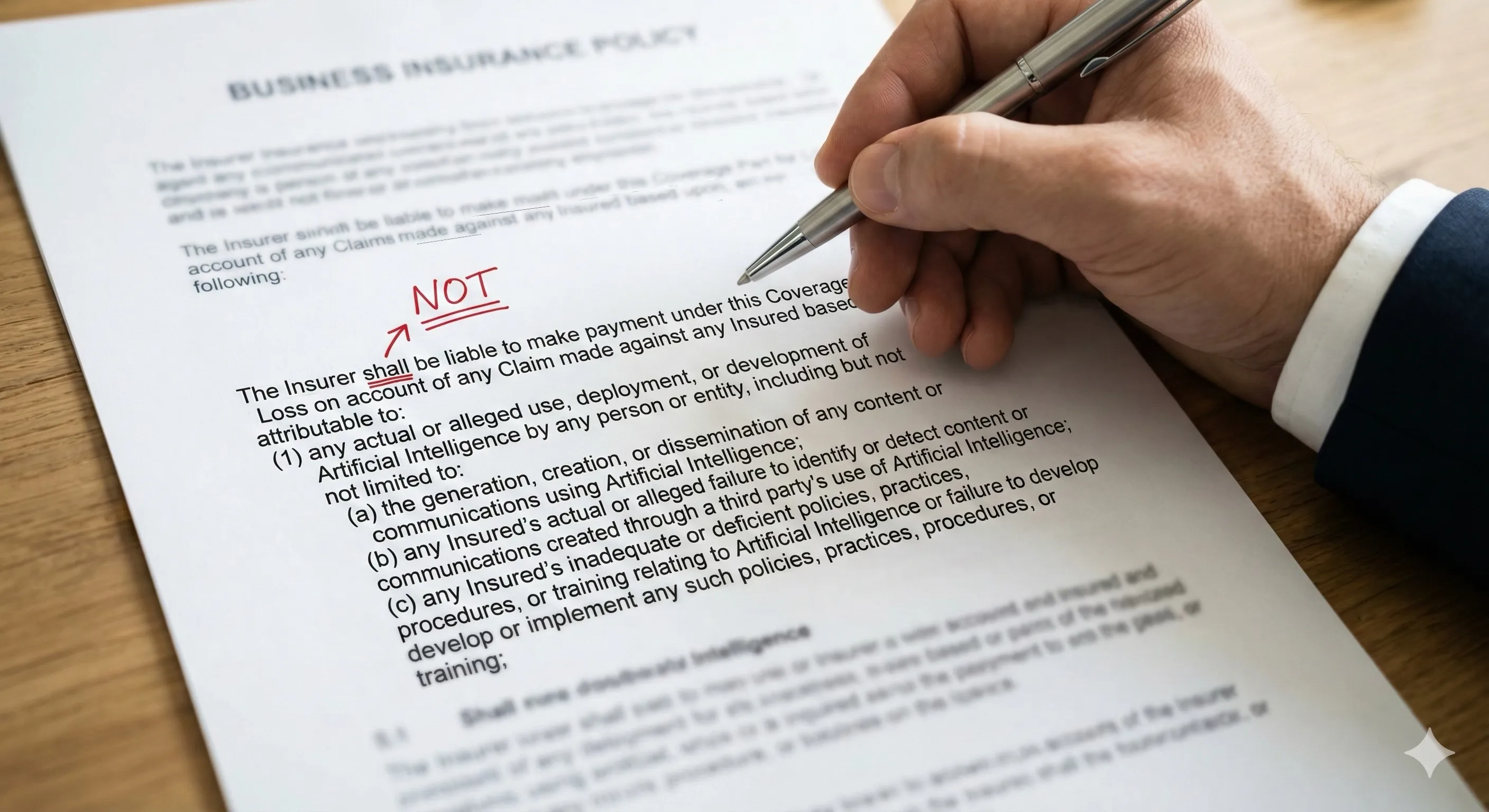
The AI Liability Squeeze
How the Insurance Industry Just Single-Handedly Redefined “Deployable AI” and What You Can Do About It
Where does AI belong in your processes?
Let us map the AI opportunities in your organization today.
Start a conversation