We quantified AI's potential impact on Utah's workforce. The numbers don't match anyone's predictions.

Jeff Whatcott · April 8, 2026
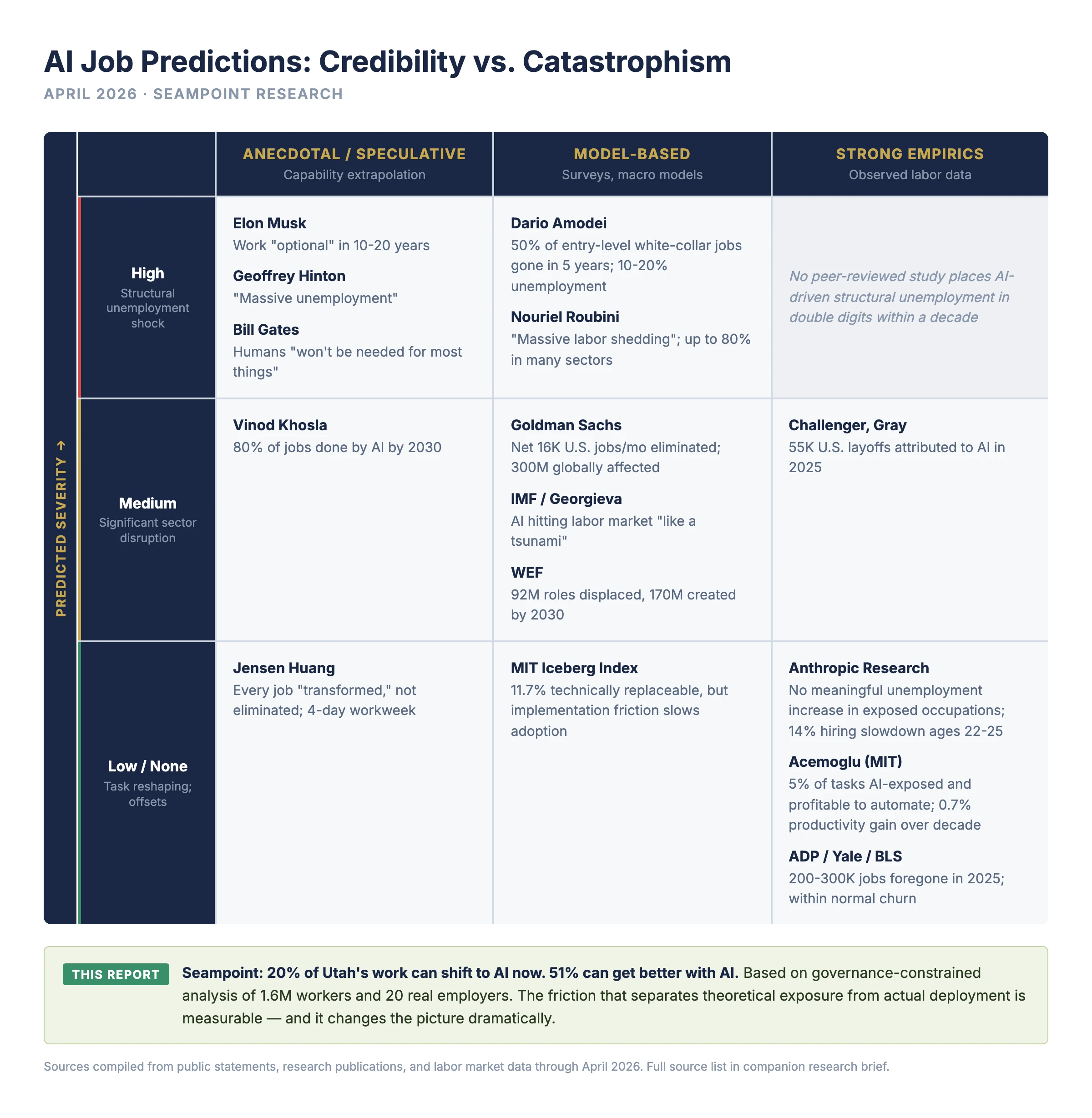
Dario Amodei says AI will wipe out 50% of entry-level white-collar jobs within five years. Vinod Khosla says 80% of all jobs will be done by AI by 2030. Geoffrey Hinton warns of “massive unemployment.” On the other side, Daron Acemoglu at MIT says only 5% of tasks are both AI-exposed and profitable to automate, projecting a 0.7% productivity gain over the next decade. Goldman Sachs put a number on it last week: a net 16,000 U.S. jobs eliminated per month.
These predictions span an order of magnitude, and the people making them are all credentialed and serious. But they share a structural problem. The catastrophists extrapolate from what AI can technically do. The empiricists measure what’s happening in aggregate labor data. Neither approach opens the hood of a real economy, examines real employers, and asks the question that actually determines deployment: can you do this safely?
We did. Earlier this year we published The Distillation of Work, a nationwide analysis of 148 million U.S. workers that applied four governance constraints to every job in the economy. That analysis used fictional employer profiles to illustrate sector patterns. This report uses real ones. We took the same methodology into Utah, analyzed 1.6 million workers across 679 occupations, and peered inside 20 real employers using publicly available data, from Intermountain Health’s 68,000 caregivers to Kirton McConkie’s 302 attorneys.
The answer is 20%. Tasks representing about 20% of Utah’s work hours can shift to AI today, and the gap between that number and the headlines exists because most predictions ignore the stewardship constraints that determine where and how AI actually gets deployed. What happens when AI gets it wrong? Who’s accountable? How much does it cost to verify? When you add those constraints, much of the theoretical exposure evaporates.
But 20% is only the beginning of what we found. The report reveals where that exposure concentrates by wage band and industry, which employer profiles show the highest and lowest AI opportunity, why half of Utah’s work hours represent a larger and more important opportunity than the tasks AI can take over, and what “pro-human AI” should actually mean in practice. Twenty employers, eight sectors, one methodology.
The full report is available now at seampoint.com/research/utah-ai-workforce-reality/.
We’re expanding this research to additional states. If you’re a policymaker, workforce agency, or employer wanting to collaborate on a state-level analysis, reach out at research@seampoint.com.
More to read

Most AI Projects Fail
Most corporate AI projects fail not because the technology is broken, but because organizations deploy AI without redesigning how work gets done. This article introduces a four-actor framework (Humans, Machines, Software, AI) for decomposing business processes and matching each action to the right actor. It is essential reading for leaders seeking AI strategy consulting that delivers measurable results, not expensive pilots.
The Great Refactor
Since late 2022, AI has been rewriting the cognitive code of work. This is not automation—it is a structural refactoring of how knowledge work gets done.
The Backstory Behind "The Distillation of Work"
Why we spent the holidays building a new way to measure AI's impact on work—and what we found mapping 18,898 tasks across 848 occupations.
Where does AI belong in your processes?
Let us map the AI opportunities in your organization today.
Start a conversation